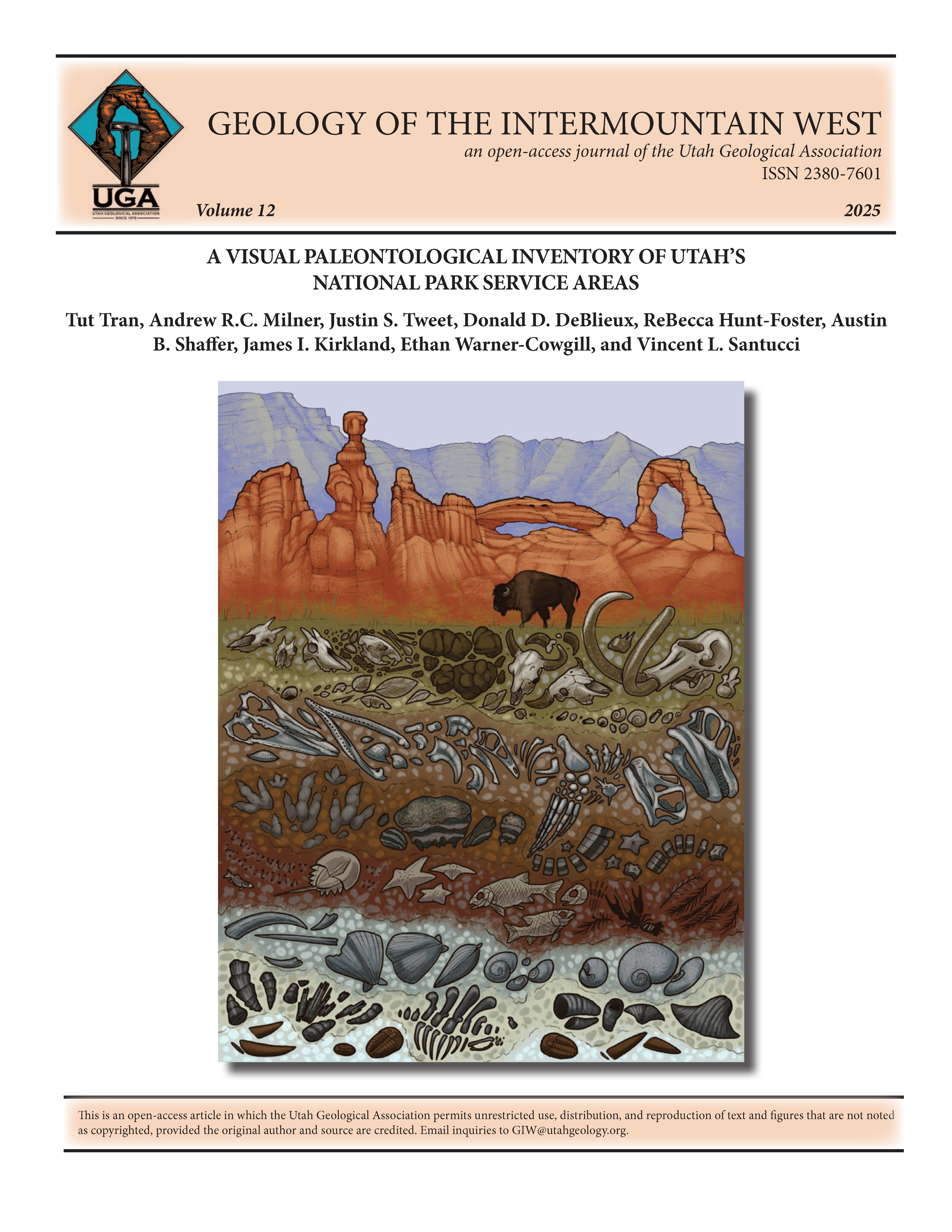
A visual paleontological inventory of Utah’s National Park Service areas
DOI:
https://doi.org/10.31711/giw.v12.pp221-292Abstract
The National Park Service (NPS) stewards 13 park units across the State of Utah, which is world-renowned for its stunning landscapes, complex geologic history, and globally significant fossil assemblages. Although most NPS areas in Utah are best known for their scenic landscapes, they all preserve geologic records with significant paleontological resources. The NPS Paleontology Program, through sustained partnership with such organizations as the Utah Geological Survey and the Utah Geological Association, has conducted years of field inventory and outreach to promote the stewardship, study, and education on paleontological resources within the NPS administered lands. The most comprehensive and publicly available literature reviews on fossils across Utah’s NPS areas were completed more than a decade ago, and numerous field inventories and publications have since been completed. This document serves as a thorough update to those previous works by providing detailed and easily comprehensible biostratigraphic diagrams with accompanying descriptions for each NPS unit in Utah. By providing this resource, this document aims to support park managers, educators, and external partners in protecting, preserving, and educating the public on the diverse and scientifically significant paleontological resources across the NPS areas of Utah.