The whole plant of Araucaria delevoryasii and Agathoxylon hoodii—giant trees with silicified wood, gently tapering trunks, araucarian seed and pollen cones, and Brachyphyllum-type leaves with cuticle from the Upper Jurassic Morrison Formation of the Howe-
DOI:
https://doi.org/10.31711/giw.v12.pp293-314Abstract
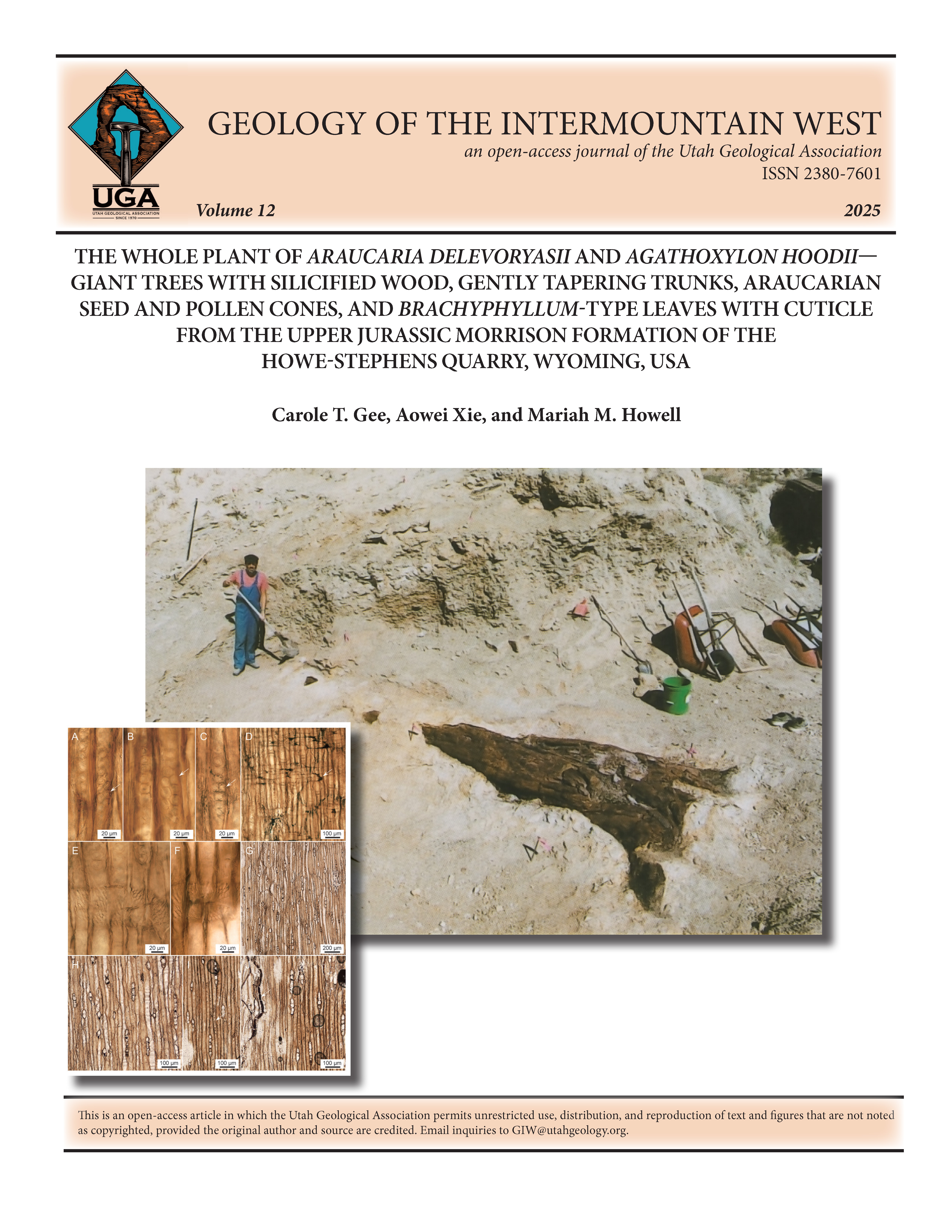
Reconstructing whole plants based on their detached parts in an assemblage is a major goal in modern paleobotany. Plant parts pertaining to an ancient species of conifer, for example, can be found as separate organ fossils such as seed cones, pollen cones, twigs with leaves, pieces of wood, and tree trunks. Although fossil conifer remains are widely known from the Upper Jurassic Morrison Formation in the Western USA, until now, conifer cone compressions and silicified wood have not yet been linked with one another to form a whole plant. Here we identify silicified wood as Agathoxylon hoodii, based on a detailed description of its anatomy, from a dinosaur bonebed in the Howe-Stephens Quarry in north-central Wyoming. In addition to numerous pieces of wood, the fossil flora in the bonebed consists of hundreds of coalified compressions of conifer seed and pollen cones, detached seed scales, abscised seeds, and branches with Brachyphyllum- type leaves previously assigned to a single species, Araucaria delevoryasii. Two giant coalified tree trunks in the quarry also pertain to this Upper Jurassic conifer, and their preserved diameters reconstruct trees with minimum heights of 74 to 78 m and 64 to 65 m, respectively. The gross morphology of the trunks, especially their taper, is also described and found to be similar to that of living Araucaria trees. Collectively, the separate fossil plant organs are recognized here as a whole plant called the Araucaria delevoryasii tree. This species of tree likely grew directly on the riverbanks of a meandering river. The paleobiogeography of Agathoxylon hoodii wood at four localities in the central Morrison Formation documents the widest extent of all Morrison wood species thus far. The compression fossils and silicified wood from the Howe-Stephens Quarry in north-central Wyoming, as well as silicified logs in Utah, represent an Araucaria tree that helped to form the old-growth Upper Jurassic conifer forests in the central Morrison Formation.