Structural and stratigraphic controls on the diagenetic evolution of the Cretaceous Baseline Sandstone, southern Nevada, U.S.A.
DOI:
https://doi.org/10.31711/giw.v13.pp53-94Abstract
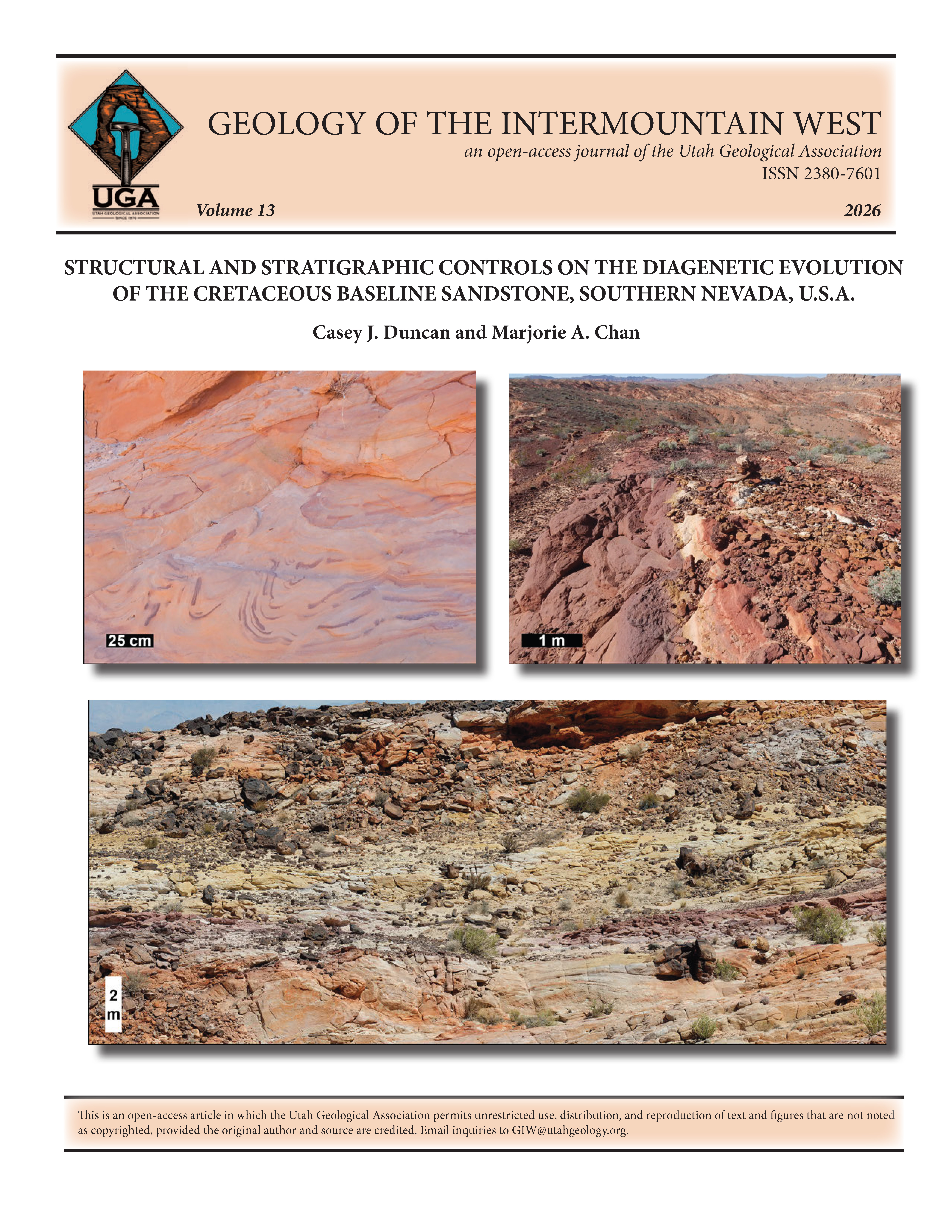
The Cretaceous Baseline Sandstone of southern Nevada is an alluvial to fluvial continental siliciclastic deposit formed in response to activity of the Summit-Willow Tank thrust. An integrated multi-scale and multi-method approach was used to characterize the diagenetic mineralogy of the formation, including traditional field mapping and description; Landsat multispectral mineral mapping; in situ reflectance spectroscopy; thin section petrography; clay fraction x-ray diffraction, x-ray fluorescence, and inductively coupled plasma mass spectrometry; and (U-Th)/He geochronology. The formation contains a wide array of iron oxide-dominant diagenetic features grouped as coloration and cementation facies. Coloration varies in hue (stark white, white/tan/gray, yellow/yellow-brown to brown, red, and purple), expression (diffuse/pastel, intense, variegated), and intensity (e.g., light to deep), which relate primarily to crystal size, mineralogy, and abundance of iron oxide grain coats (goethite vs hematite) and cement. Cementation facies vary in mineralogy with iron oxide generally prevalent, and carbonate abundant only in the upper red sandstone member. Rare silica-replaced fragments of the tree fern Tempskya(?) occur in the upper white sandstone to lower red sandstone members. Iron oxide cementation facies consist of ironstone horizon and concretionary types, which vary widely in size and morphology.
Integration of data across spatial scales indicates that coloration and iron oxide cementation patterns formed within three diagenetic stages. The eogenetic stage was influenced by surface processes related to the depositional environment along with basin-scale fluid flow from the Sevier orogeny. The mesogenetic stage followed by additional remobilization of iron during shallow to moderate burial. A late phase of telogenetic fluid flow, likely of meteoric infiltration origin, resulted in intense localized alteration along the Miocene-aged Baseline fault with latest-stage carbonate mineralization occurring along joints and as pendant cements.