A clastic pipe in the Miocene Horse Spring Formation of southern Nevada—implications for shear-zone seismicity between the Pacific and North American plates
DOI:
https://doi.org/10.31711/giw.v13.pp95-106Abstract
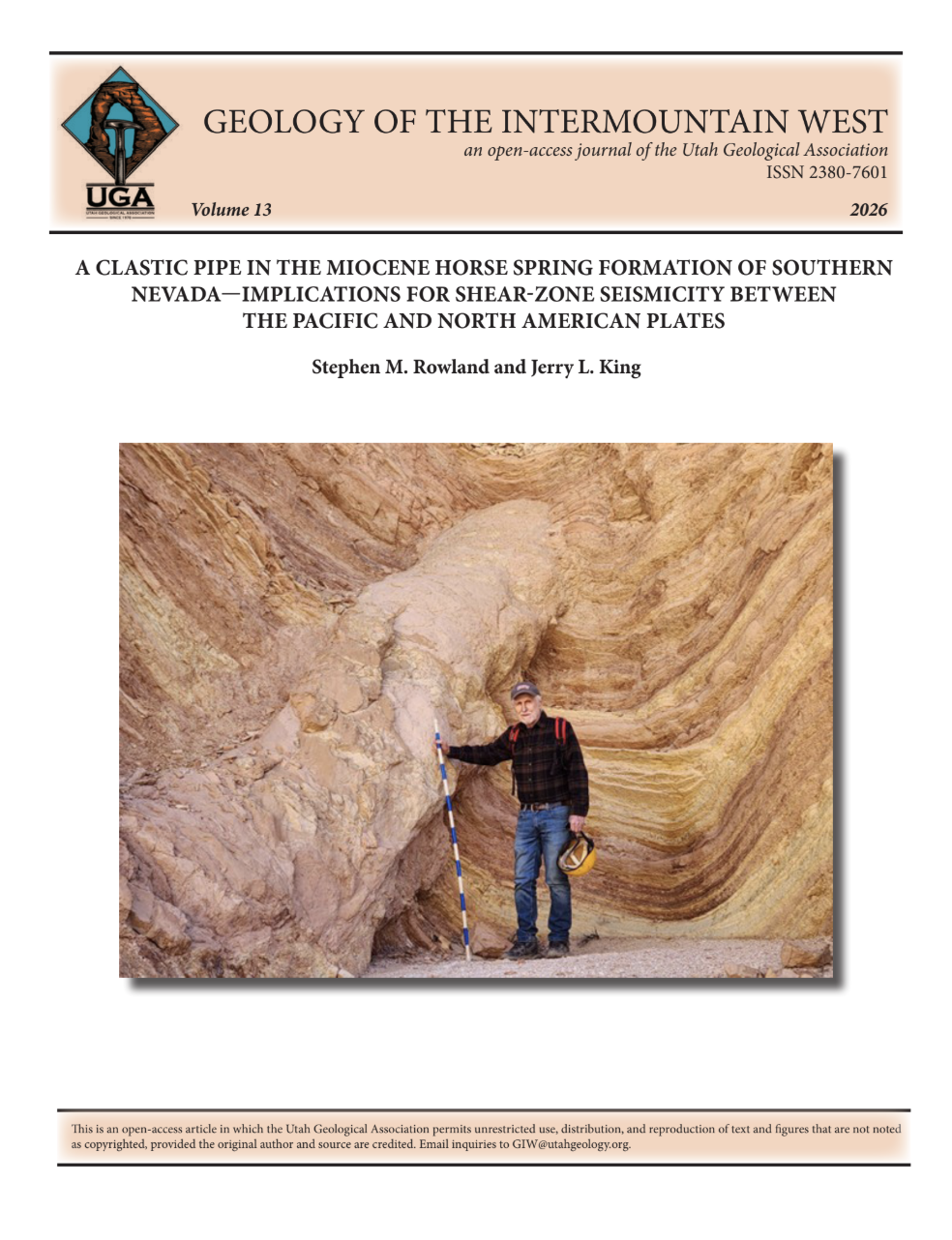
We describe and interpret a large, cylindrical, sedimentary structure, 5.1 m long and 1.2 m in diameter exposed in a tributary to Lovell Wash, near Lake Mead in southern Nevada. It occurs within the mid-Miocene Horse Spring Formation. We interpret this structure to be a seismically triggered clastic pipe. Clastic pipes are common and well-studied in the Jurassic of the Colorado Plateau; however, no such structures have previously been recognized in the Miocene of southern Nevada; thus, this is a highly anomalous feature in this region. The Horse Spring consists of fluvial and lacustrine sediments deposited in a basin that formed during Miocene extension of the Basin and Range Province. Abundant 40Ar/39Ar-dated tuffs in this formation permit us to date the injection of the Lovell Wash clastic pipe at about 13.7 Ma. Paleoliquefaction features and intrastratal folds and faults in the Horse Spring document the occurrence of large earthquakes during its deposition. An earthquake on the nearby Las Vegas Valley shear zone most likely triggered the injection of the Lovell Wash clastic pipe. Motion within this shear zone began roughly 13 Ma, initiating dextral faulting within the nascent Walker Lane−Eastern California shear zone, which now accommodates approximately 20% of the relative motion between the Pacific and North American plates. The Lovell Wash clastic pipe thus represents a harbinger of the development of the Walker Lane−Eastern California shear zone and the divergence of the Pacific and North American plates.