Claron basin provenance shift from Sevier-Laramide compression to Basin and Range extension
Detrital zircon geochronology from the Eocene-Oligocene Brian Head Formation, Utah
DOI:
https://doi.org/10.31711/giw.v12.pp155-168Abstract
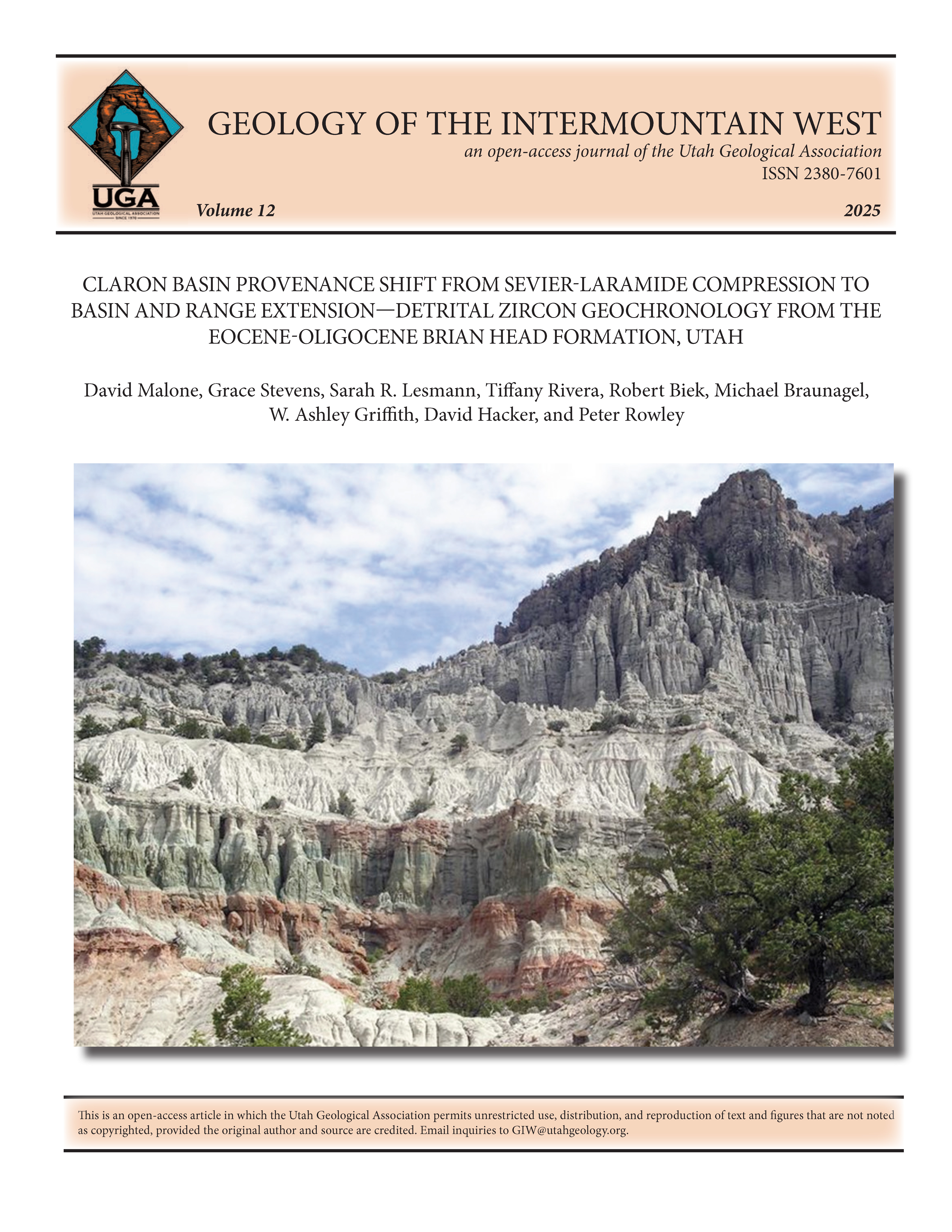
The Eocene-Oligocene Brian Head Formation is the basal volcanic unit throughout much of the southern Marysvale volcanic field but rests atop Sevier-Laramide synorogenic strata of the Claron foreland basin in southern Utah. The Brian Head Formation reaches 300 m in thickness and consists of light-colored volcaniclastic sandstone, siltstone, mudstone, and minor conglomerate and airfall tuff; in northern exposures, the upper part locally contains a volcanic section of lava flows, ash-flow tuff, and volcanic mudflow breccia. These rocks were deposited in a slowly aggrading fluvial to lacustrine depositional environment distal tothe Indian Peak caldera complex to the west. We sampled three volcaniclastic sandstone units near the top of the formation, specifically near Haycock Mountain and along the southern and western flanks of the Sevier Plateau near Casto Butte and Blind Spring Mountain. The sandstone beds are compositionally and texturally immature and classify as lithic and arkosic wacke. U-Pb geochronological data for samples from the three sites were obtained on zircon by inductively coupled plasma mass spectrometry (ICP-MS) at the University of Arizona Laserchron Center. A total of 370 zircon crystals were analyzed. Most zircons were pale, translucent, and euhedral. The detrital zircon age spectra of the three sites are statistically indistinguishable. Each sample contained greater than 80% Paleogene zircons and had prominent age peaks of about 34.5 Ma. We interpret that the maximum depositional age is about 33.4 Ma. Older zircons range from Mesozoic to Archean in age. We suggest that the Brian Head Formation was sourced from the Indian
Peak caldera and its environs, which are greater than 150 km to the west. Thus, Brian Head deposition in the Claron basin represents the transition from a Sevier-Laramide foreland basin characterized by the synorogenic Claron Formation to a system dominated by more distally derived sediments from the Indian Peak caldera complex, which is probably the most prominent eruptive center on the Nevadaplano uplift.