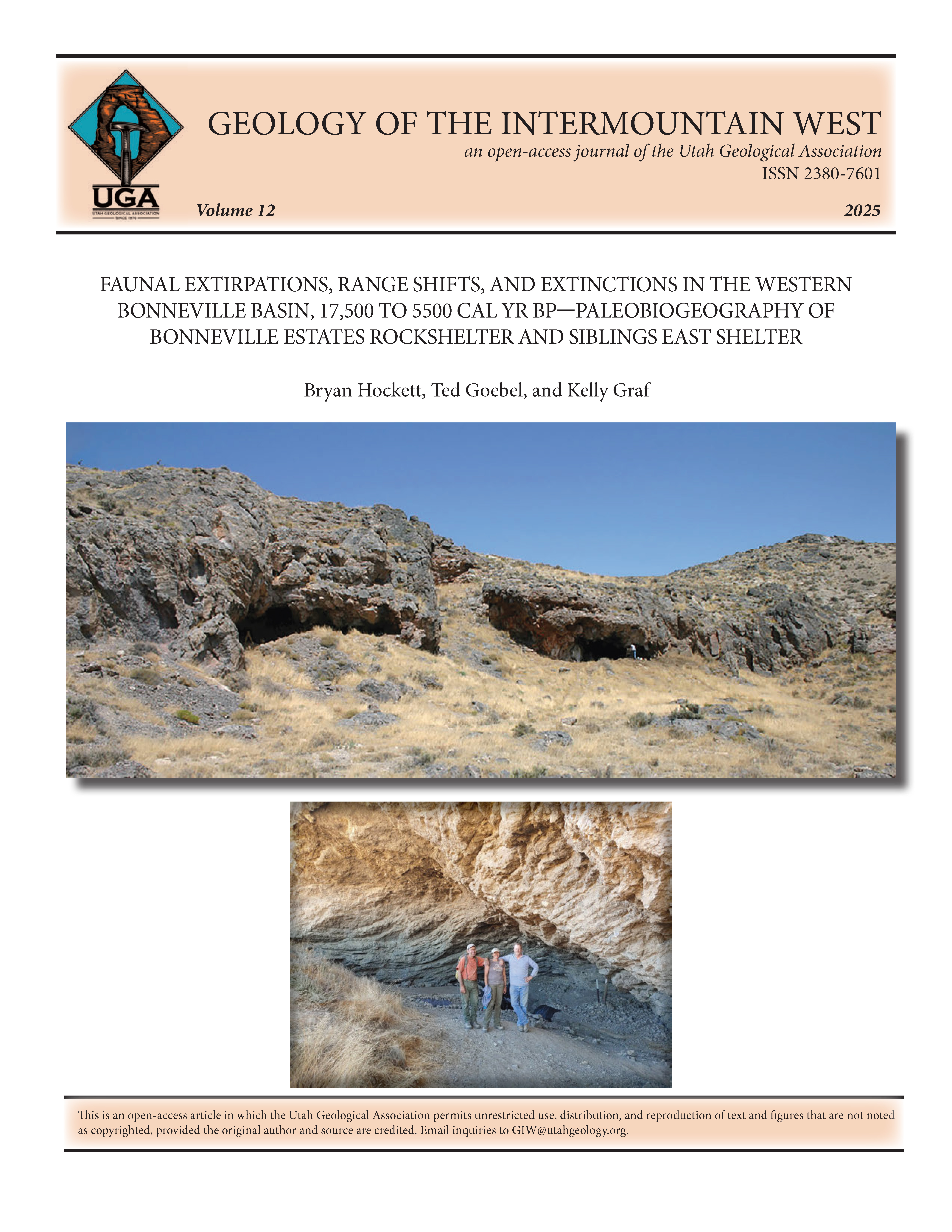
Faunal extirpations, range shifts, and extinctions in the western Bonneville basin, 17,500 to 5500 cal yr BP
Paleobiogeography of Bonneville Estates Rockshelter and Siblings East Shelter
DOI:
https://doi.org/10.31711/giw.v12.pp169-200Abstract
We analyzed faunal remains from two rockshelters in the far western Bonneville basin of eastern Nevada: Bonneville Estates Rockshelter and Siblings East Shelter. The analysis focused on paleobiogeographic changes between 17,500 and 5500 cal yr BP. Bonneville Estates Rockshelter contains faunal remains dating to the Heinrich 1 Stadial (18,000 to 14,700 cal yr BP), whereas both shelters contain faunal remains dating to the Bølling-Allerød Interstadial (14,700 to 12,900 cal yr BP), Younger Dryas Stadial (12,900 to 11,700 cal yr BP), Early Holocene (11,700 to 9300 cal yr BP), and Middle Holocene (9300 to 5500 cal yr BP). Identified faunal remains from these records indicate cool and either moist or dry climate compared to today between 17,500 and 10,200 cal yr BP, and increasingly warm temperatures impacting animal biogeographies beginning in the latter stages of the Younger Dryas and first one-half of the Early Holocene, culminating in xeric-adapted species like today by 9300 cal yr BP. Bonneville Estates Rockshelter also contains specimens of either gray wolf (Canis lupus) or the extinct dire wolf (Aenocyon dirus) and one felid phalanx of either puma/cougar (Puma concolor) or the extinct North American “cheetah” (Miracinonyx trumani), whereas Siblings East Shelter contains a rib of an extinct large horse of the genus Equus. Radiocarbon dated faunal remains were found directly atop Lake Bonneville beach gravels deposited inside Siblings East Shelter on the Provo
terrace of Lake Bonneville, suggesting the lake dropped from this elevation prior to 14,300 cal yr BP.