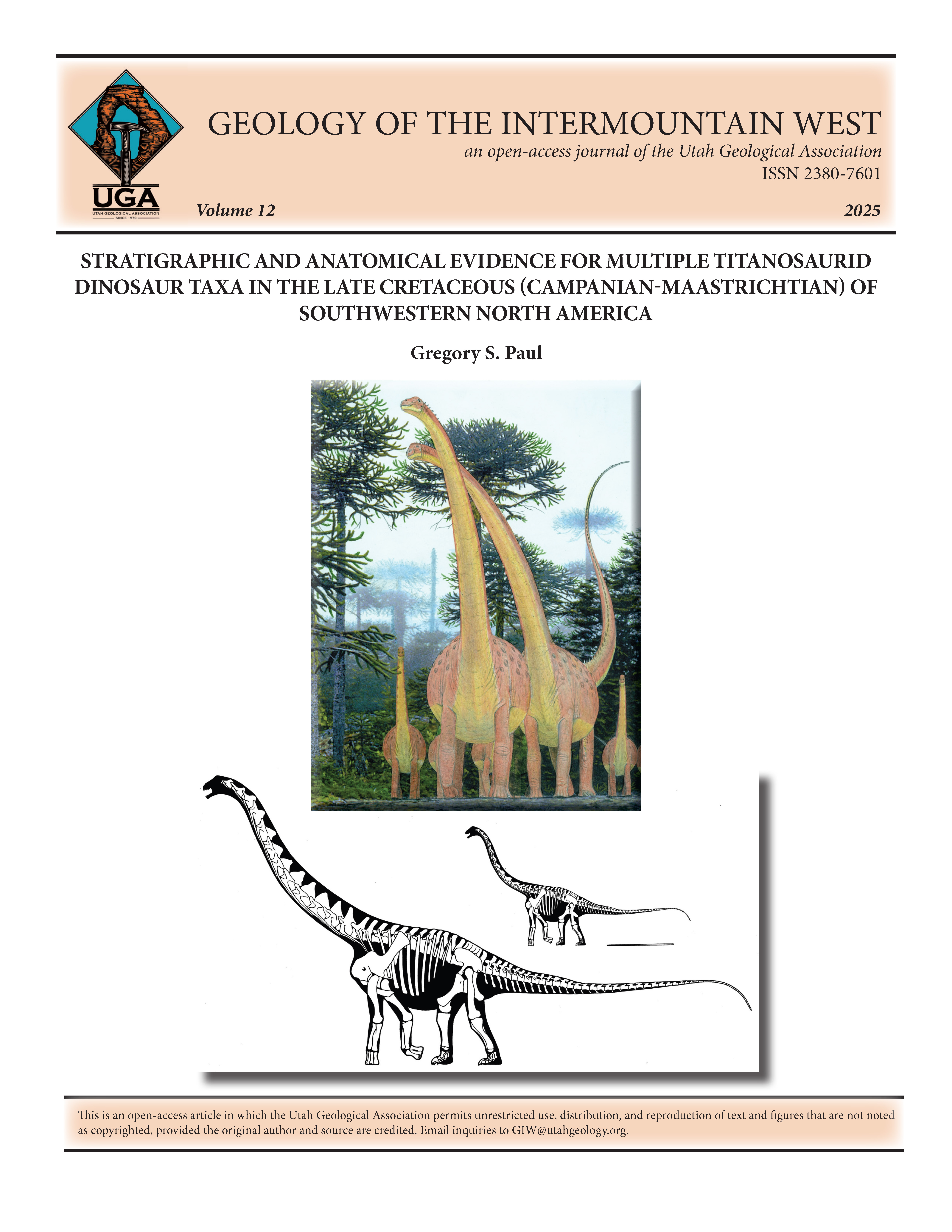
Stratigraphic and anatomical evidence for multiple titanosaurid dinosaur taxa in the Late Cretaceous (Campanian-Maastrichtian) of southwestern North America
DOI:
https://doi.org/10.31711/giw.v12.pp201-220Abstract
After the return of giant sauropod dinosaurs in the form of titanosaurids to North America in the Campanian of the Late Cretaceous, Alamosaurus sanjuanensis is generally considered to have been the sole taxon on the continent over a few million years. The possibility of one species existing that long is very low because sauropods often exhibit taxonomic diversity in the same habitat. The fossils from the southwestern states and northern Mexico are all incomplete, overlapping elements are often scarce, and sometimes differ in ontogenetic development. The fragmentary New Mexican A. sanjuanensis material from the early Maastrichtian lower Ojo Alamo Formation shows significant distinctions from the much later partial skeletons from the late Maastrichtian lower North Horn Formation of Utah. The latter is therefore made the holotype of Utetitan zellaguymondeweyae. Some late Maastrichtian Texas fossils can be assigned to U. zellaguymondeweyae, others cannot. Fossils from the middle Campanian cannot be assigned to either genus. Southwestern North America supported a diversity of titanosaurids, which may have formed a Utetitan miniclade as they evolved in semi-isolation from the global titanosaurid fauna. Past calculations that these titanosaurids were among the most massive in the group are not borne out by scaling of skeletal restorations.