The geologic glory of the Lower Jurassic Navajo Sandstone, southern Utah
DOI:
https://doi.org/10.31711/giw.v13.pp107-174Abstract
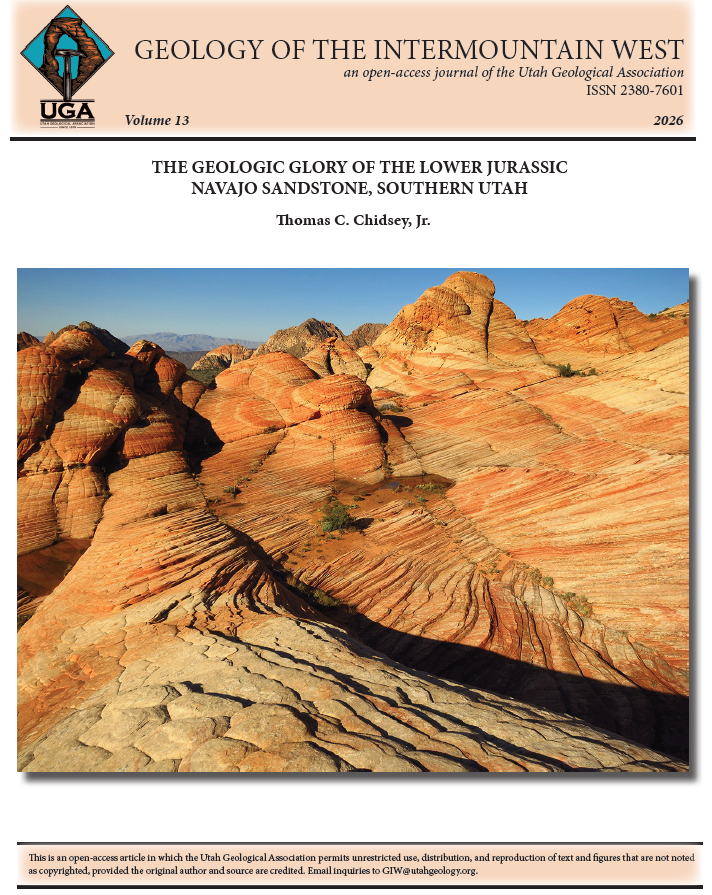
The eolian Lower Jurassic Navajo Sandstone is a “glorious” geologic formation famous for its spectacular cross-bedding, magnificent cliffs, rounded sandstone domes, and countless beautiful canyons in southern Utah. The Navajo is a favorite of many geologists and is a large part of what makes southern Utah a favorite destination for tourists, outdoor enthusiasts, geology students, and researchers.
The Navajo Sandstone was deposited in a hot, arid setting as part of a great Sahara-like eolian erg landscape of huge dunes with interdune oases, wadis, and sand sheets. The sand was originally sourced, in part, from the northern Appalachian region and Canadian highlands far to the east and northeast, transported by sand-laden river systems along a circuitous route (north, northwest, west, and then south) to the western part of the continent, deposited in a large delta system, and then during times when parts of the delta
dried, was blown into the Utah area from the north and northwest. Navajo bedding types and sedimentary structures include those found in modern sand dunes such as tabular, wedge, and textbook-quality trough cross-bedding; wind ripples; grainfall, grainflow, and avalanche deposits; and soft-sediment deformation.
The formation is called the Navajo Sandstone in central and southern Utah, northern Arizona, and western Colorado and New Mexico, and is age-equivalent to the upper part of the Nugget Sandstone in northern Utah and western Wyoming. The Navajo ranges in thickness from a depositional pinchout to 2300 feet [0–700 m]. It is separated from overlying Middle Jurassic Carmel/Temple Cap Formations by the J-1 unconformity that represents a hiatus of 10 million years.
The Navajo sandstone beds are friable and composed of clean, fine- to medium-grained, frosted, subrounded to subangular, moderately to well-sorted quartz sand. Sandstone beds are locally bleached by iron-reducing hydrocarbons, weak acids, or hydrogen sulfide. At least eight subfacies, three eolian dune and five non-eolian interdune, have been identified in the Navajo deposits. In two subfacies, thin-bedded sandy microbial (algal) boundstone and wackestone composed of limestone or dolomitic limestone were
deposited in interdunal oases.
The Navajo Sandstone has a number of unique features. These include weirdly shaped iron- and manganese-rich diagenetic pipes and columns, beautiful alcoves and hanging gardens, weathered-out iron concretions (Moki marbles) that serve as an analog to “blueberries” found on Mars, unusually contorted bedding formed by soft-sediment deformation, honeycomb (tafone) weathering, and weathered out deformation bands.
The Navajo Sandstone serves as a reservoir for both hydrocarbons and carbon dioxide (CO2) in central and east-central Utah. Covenant oil field in the central Utah thrust belt has produced almost 34 million barrels of oil since its discovery in 2004. The Navajo is also a significant disposal unit for produced water at Covenant and Drunkards Wash (a large field producing coalbed methane from the Cretaceous Ferron Formation off the northwest flank of the San Rafael Swell. Cores from the Navajo reservoir in Covenant field
display many of the same dune and interdune subfacies and other eolian characteristics described from outcrops in the San Rafael Swell to the east. In addition to an oil and gas reservoir, the Navajo is a major aquifer for culinary water supplied to the growing St. George metropolitan area in southwestern Utah and for the Navajo Nation in the Four Corners area in southeastern Utah.
Finally, the Navajo Sandstone has great potential for the geologic storage/sequestration of CO2 that could be captured from coal-fired power plants in the Castle Valley/eastern Wasatch Plateau area. The Navajo is also being investigated for storage of CO2 produced as a waste product at a proposed iron ore processing plant in the Iron Springs mining district at the eastern margin of the Basin and Range Province in southwestern Utah.