Skip to main content Skip to main navigation menu Skip to the current issue Skip to site footer

Geology of the Intermountain West

Utah Geological Association Logo
  • Current
  • Archives
  • Search
    • Titles
  • About
    • About the Journal
    • Submissions
    • Editorial Team
    • Privacy Statement
    • Contact
Search
  • Login

Current Issue

Vol. 13 (2026): Geology of the Intermountain West
					View Vol. 13 (2026): Geology of the Intermountain West
DOI: https://doi.org/10.31711/giw.v13
Published: 2026-02-06

Articles

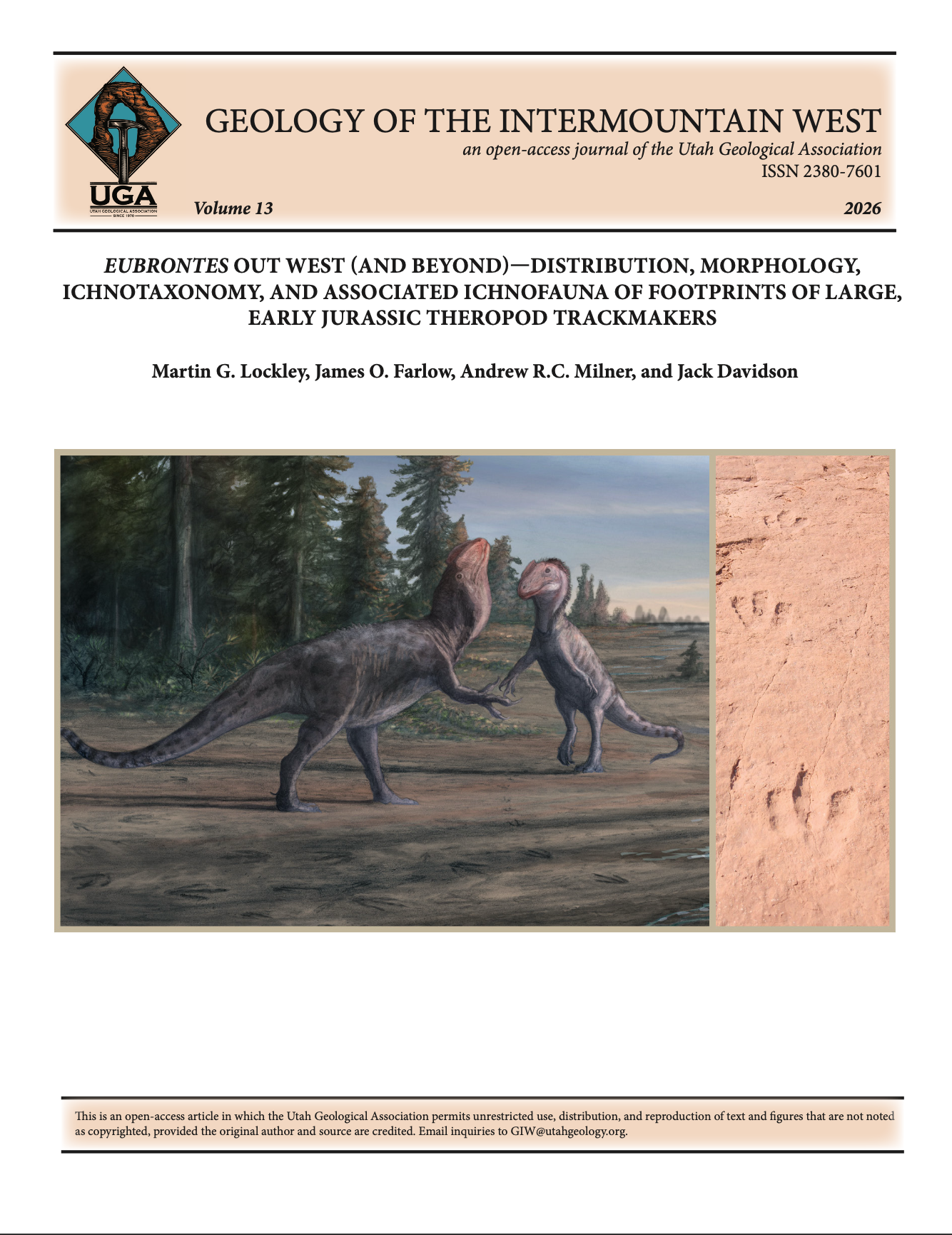
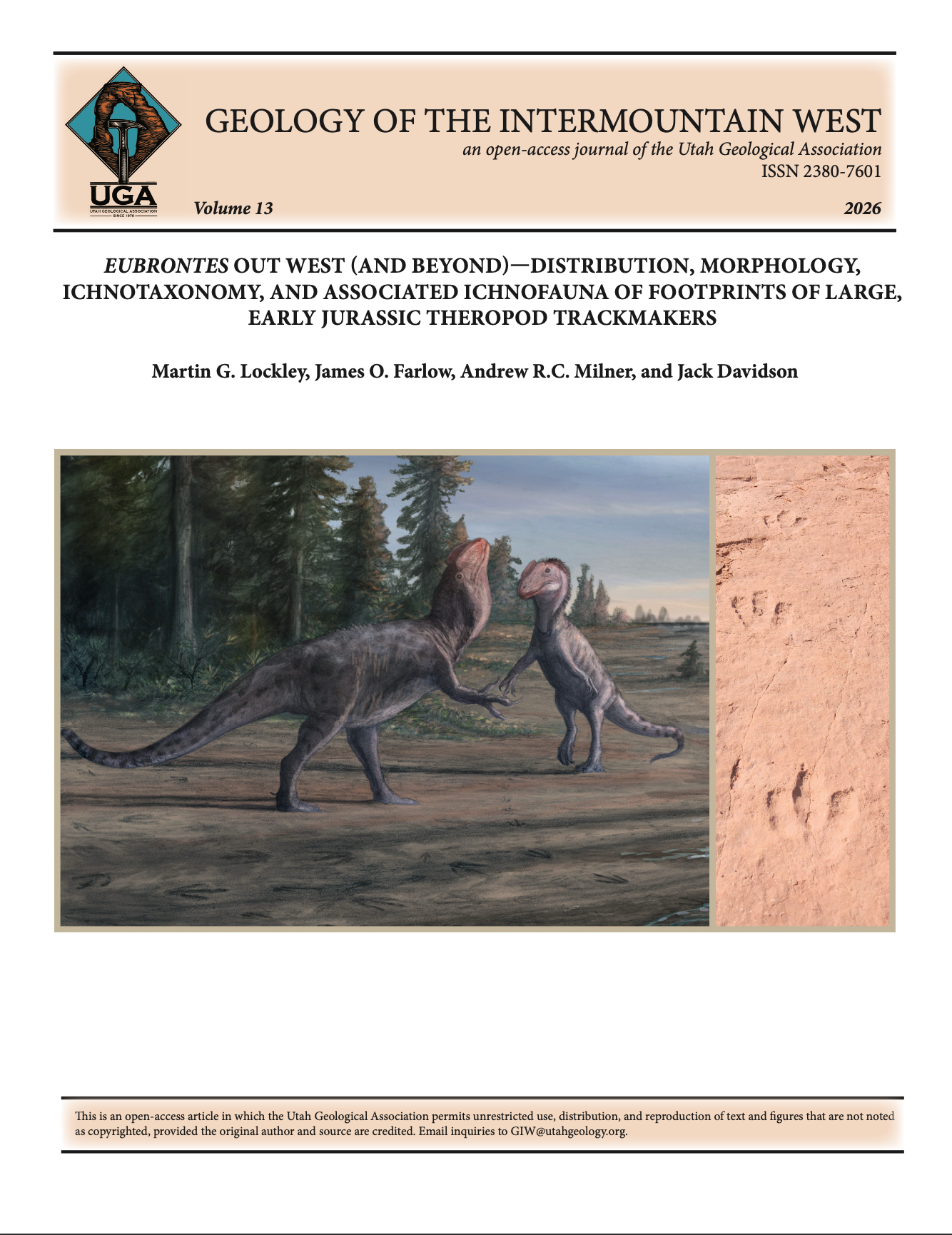
  • Left: Two Dilophosaurus producing Eubrontes footprints. Portion of an illustration called the "Kay- enta Timeline" by Brian Engh, LivingRelicProduc- tions.com, commissioned by the St. George Dinosaur Discovery Site. Right: Three Eubrontes tracks in a trackway in the lower Kayenta Formation at the Warner Valley Tracksite, Washington County, Utah. Photograph by Andrew Milner.

    Eubrontes out west (and beyond)—distribution, morphology, ichnotaxonomy, and associated ichnofauna of footprints of large, Early Jurassic theropod trackmakers

    Martin G. Lockley, James O. Farlow, Andrew R.C. Milner, Jack Davidson
    1-51
    • PDF
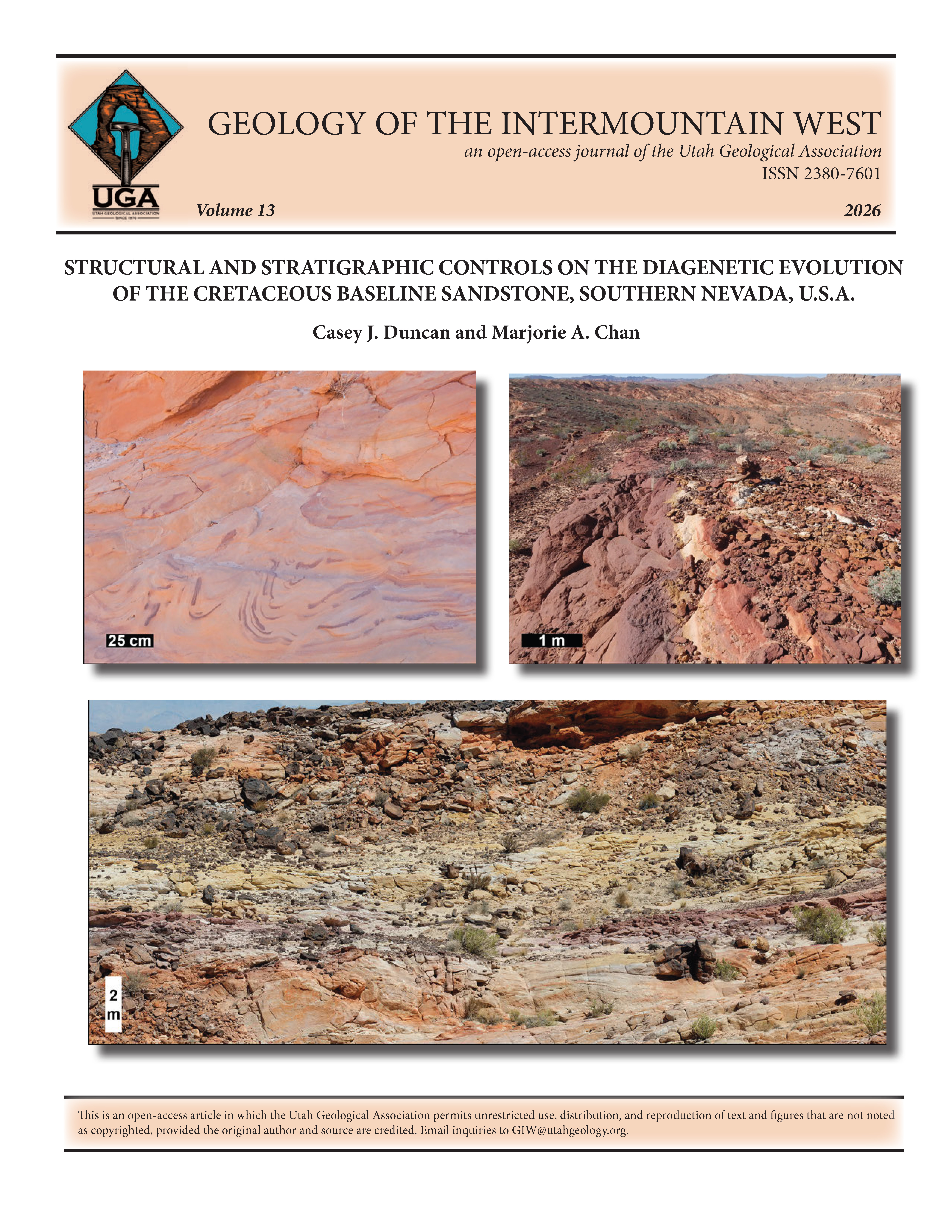
  • Views of the coloration facies of the white and red sandstone members of the Baseline Sandstone in the Muddy Mountains area, Nevada. Top left: purple coloration patterns found along soft-sediment deformation surfaces in the lower red sandstone member. Top right: intensely concentrated red and purple coloration in the red sandstone member. Bottom: outcrop panorama showing the range in coloration of the white sandstone member and its typical diffuse expressions (scale bar indicates stratigraphic thicknesses of lowest beds).

    Structural and stratigraphic controls on the diagenetic evolution of the Cretaceous Baseline Sandstone, southern Nevada, U.S.A.

    Casey J. Duncan, Marjorie A. Chan
    53-94
    • PDF
    • PDF - Print
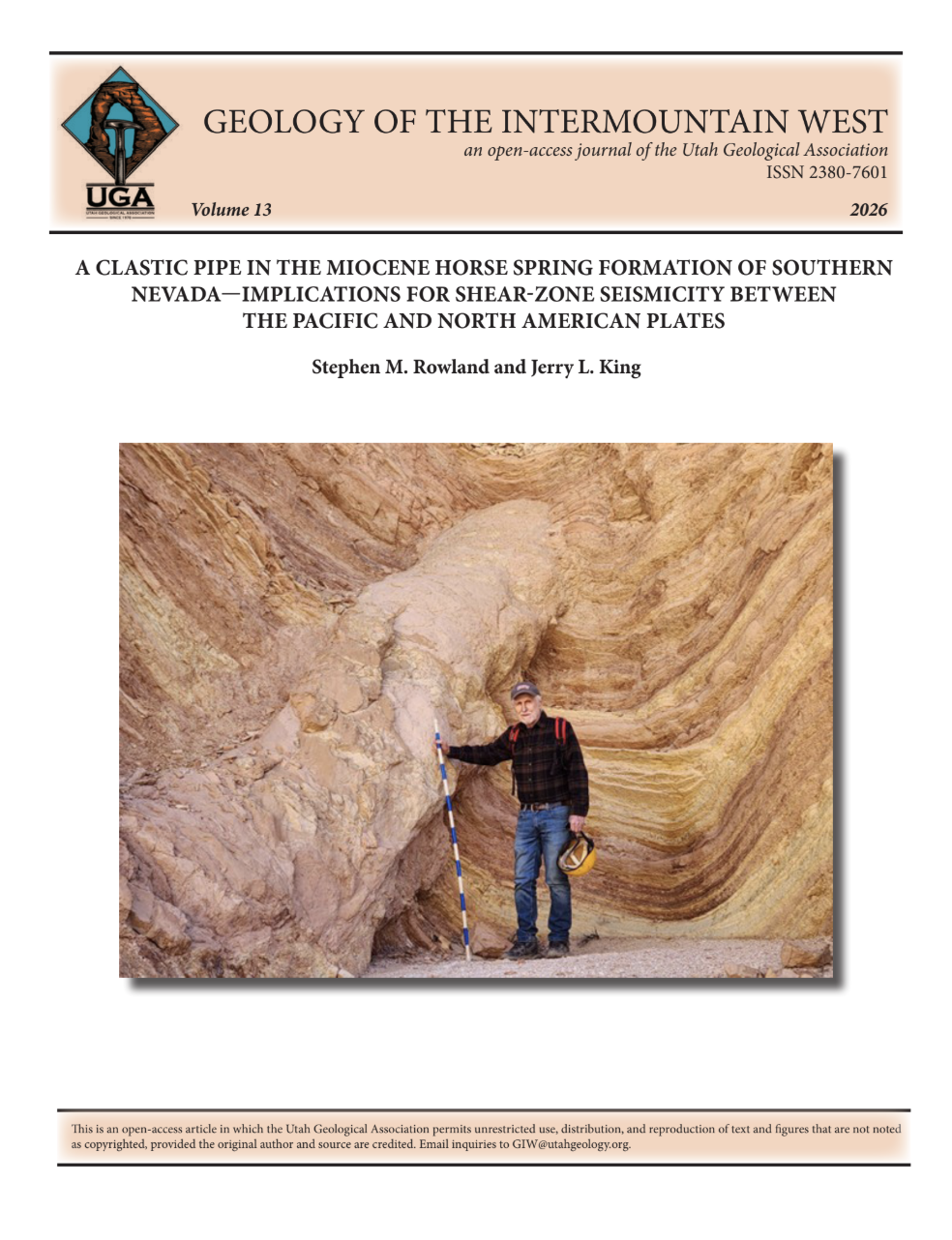
  • Stephen M. Rowland stands next to the Lowell Wash clastic  pipe—a seismically triggered clastic pipe oriented perpen- dicular to bedding in the Miocene Horse Spring Formation  of southern Nevada. Rod is 1.5 m long, calibrated in dm. Photograph by Gregg Wilkerson.

    A clastic pipe in the Miocene Horse Spring Formation of southern Nevada—implications for shear-zone seismicity between the Pacific and North American plates

    Stephen M. Rowland, Jerry L. King
    95-106
    • PDF - Print
    • PDF
View All Issues
Make a Submission

Language

  • English

Information

  • For Readers
  • For Authors
  • For Librarians

Browse

  • Categories
Open Journal Systems Hosting and Support by: OpenJournalSystems.com